- English
- Español
- Português
- русский
- Français
- 日本語
- Deutsch
- tiếng Việt
- Italiano
- Nederlands
- ภาษาไทย
- Polski
- 한국어
- Svenska
- magyar
- Malay
- বাংলা ভাষার
- Dansk
- Suomi
- हिन्दी
- Pilipino
- Türkçe
- Gaeilge
- العربية
- Indonesia
- Norsk
- تمل
- český
- ελληνικά
- український
- Javanese
- فارسی
- தமிழ்
- తెలుగు
- नेपाली
- Burmese
- български
- ລາວ
- Latine
- Қазақша
- Euskal
- Azərbaycan
- Slovenský jazyk
- Македонски
- Lietuvos
- Eesti Keel
- Română
- Slovenski
- मराठी
- Srpski језик

Where exactly lies the difference between high‑quality and poor‑quality hydraulic cylinders II?
Machining Accuracy & Geometric Tolerances — For Smooth Operation
Material determines service life, while machining accuracy determines how well the cylinder performs.
Hydraulic systems require micron‑precision fits; tiny dimensional errors get significantly amplified under pressure.
1. Cylinder Tube Bore Machining: Cost Gap between Honing and Roller Burnishing (SRB)
The inner surface of the cylinder tube is where piston sealing rings undergo continuous friction, requiring extremely strict surface roughness and geometric tolerances.
Standards for high‑quality cylinders
The inner bore of premium‑grade cylinder tubes must be processed by precision honing or roller burnishing (SRB). Roundness and cylindricity tolerances of the bore shall be controlled within ≤0.02 mm, with surface roughness achieving Ra ≤0.2 μm.
The finished bore features a mirror‑like surface. This not only minimizes frictional resistance, but also enables sealing components to operate under optimal surface conditions, multiplying their service life several‑fold.
Reality of low‑cost workshop production
Lacking high‑value precision honing equipment that costs millions, low‑budget workshops often perform simple machining using ordinary boring machines or even internal grinding machines. The resulting surface roughness only reaches Ra 0.8 μm or worse. Visible waviness and tool marks can be clearly felt by touch or seen with naked eyes.
When piston sealing rings rub against this sandpaper‑like inner wall, they will wear flat within less than three months, resulting in severe internal leakage of the cylinder.
2. Coaxiality and Geometric Tolerances: Avoid Cylinder Crawling and Abnormal Noise
For a high‑quality hydraulic cylinder, when pushing and pulling the piston rod by hand without hydraulic oil supply, the resistance should be even and smooth.
High‑precision fitting
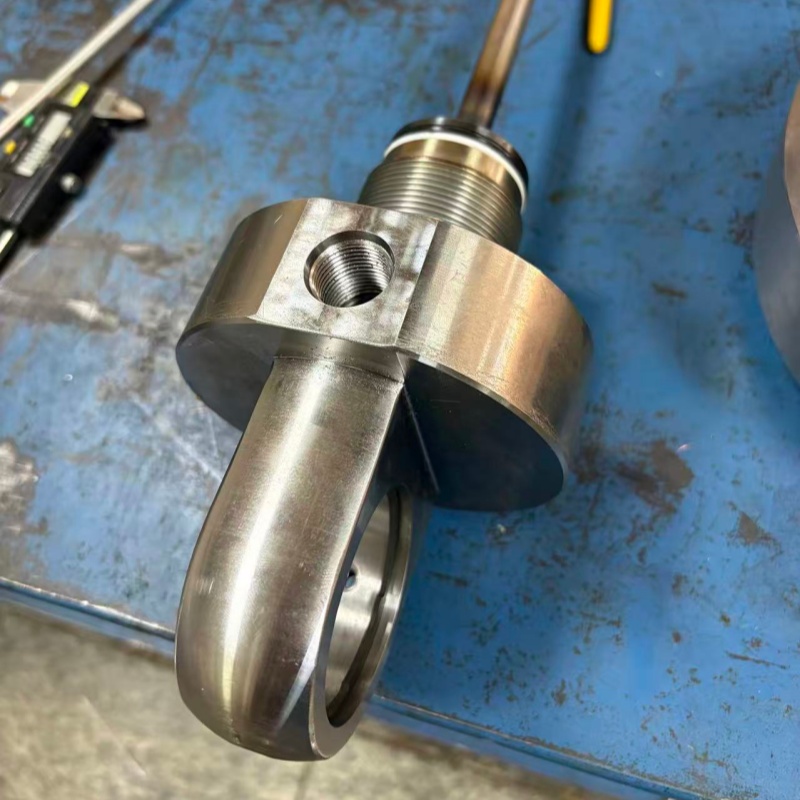
Reputable manufacturers machine the front end cap, guide sleeve and piston in a single‑setup operation on CNC turn‑mill centers. This ensures perfect alignment among the centerlines of piston, guide sleeve and cylinder tube, with coaxiality error ≤0.03 mm.
Low‑precision component assembly
Small workshops commonly produce parts separately on conventional lathes. After assembly, coaxiality errors far exceed allowable limits. This causes binding stress when the piston rod extends or retracts.
At low‑speed operation, the cylinder exhibits jerky “crawling” movement. Under high‑pressure conditions, the guide sleeve suffers severe one‑sided wear, which may even result in piston rod seizure.
Conclusion
Premium hydraulic cylinders excel in superior materials and precise craftsmanship, delivering long-term reliability and peace of mind.Rather than chasing low-cost inferior products, choosing technically rigorous, well-engineered cylinders ensures stable equipment operation and sustainable business development.We welcome your inquiries for any hydraulic cylinder requirements.