- English
- Español
- Português
- русский
- Français
- 日本語
- Deutsch
- tiếng Việt
- Italiano
- Nederlands
- ภาษาไทย
- Polski
- 한국어
- Svenska
- magyar
- Malay
- বাংলা ভাষার
- Dansk
- Suomi
- हिन्दी
- Pilipino
- Türkçe
- Gaeilge
- العربية
- Indonesia
- Norsk
- تمل
- český
- ελληνικά
- український
- Javanese
- فارسی
- தமிழ்
- తెలుగు
- नेपाली
- Burmese
- български
- ລາວ
- Latine
- Қазақша
- Euskal
- Azərbaycan
- Slovenský jazyk
- Македонски
- Lietuvos
- Eesti Keel
- Română
- Slovenski
- मराठी
- Srpski језик

Where exactly lies the difference between high‑quality and poor‑quality hydraulic cylinders?
Before installation and pressurized commissioning, when placing two cylinders with a 3‑fold price difference side‑by‑side, ordinary buyers and even many experienced procurement specialists cannot spot any substantial difference merely by visual inspection of paint finish and electroplated surfaces.
Nevertheless, as the “muscle and heart” of hydraulic systems, cylinders have to withstand instantaneous impact loads of tens or even hundreds of tons. Poor‑quality cylinders frequently reveal their defects only two to three months after being put into service. Typical failures include power loss caused by internal leakage, external oil leakage, jerky cylinder movement (crawling), and in severe cases, cylinder tube bursting.
The core structure and component distribution of the hydraulic cylinder
To understand their value gap, you first need to know their internal construction. A hydraulic cylinder is not a simple monolithic unit, but a system assembled from dozens of precision components with tight fit tolerances.
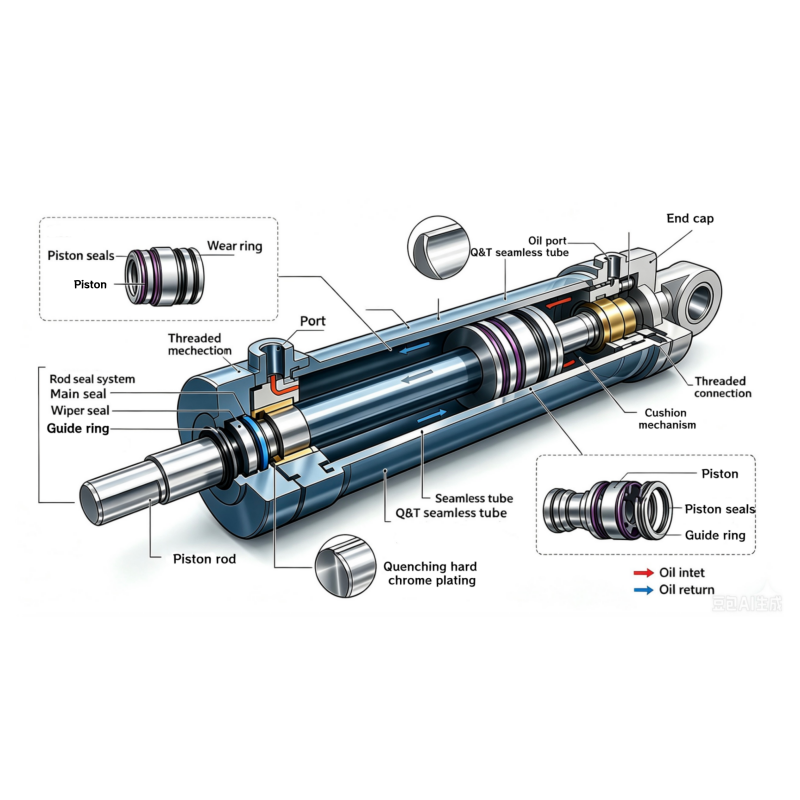
As shown in the figure above, the core of a hydraulic cylinder consists of cylinder tube, piston rod, piston and sealing system.
Of total manufacturing cost:
• Materials: ~45%
• Machining & precision control: ~35%
• High‑performance seals & auxiliaries: ~12%
• The rest: full‑inspection & quality control — costs frequently eliminated by low‑end manufacturers.
Next, we will conduct an in‑depth analysis of the essential differences between high‑quality and low‑quality cylinders from the aspect of material and heat treatment first.
Material & Heat Treatment: Determines the "Skeleton Service Life" of Hydraulic Cylinders
Materials are the foundation of all industries. Premium‑grade cylinders invest heavily in unseen steel substrates and heat‑treatment processes, while low‑cost cylinders frequently cut corners on hidden internal material specifications.
1. Cylinder Tube: Fundamental barrier against bulging and bursting
The cylinder tube endures continuous high‑pressure impact from internal hydraulic oil. According to hydrodynamics formulas, the tangential stress on the tube wall is proportional to internal working pressure and inner diameter.
Material selection & processing for high‑quality cylinders:
High‑performance cylinders generally adopt premium seamless steel tubes of Grade 20, Grade 45 or 27SiMn (manganese‑vanadium steel). Furthermore, incoming steel tubes must undergo strict quenching‑and‑tempering heat treatment.
Quenching‑and‑tempering (quenching plus high‑temperature tempering) delivers excellent comprehensive mechanical properties for steel: high hardness combined with outstanding toughness, enabling resistance against instantaneous over‑pressure shock (e.g. reverse impact pressure when an excavator bucket hits boulders).
Potential risks of low‑quality cylinders:
To cut costs, budget‑priced cylinders often use cheap commercial welded tubes or non‑heat‑treated cold‑drawn fluid pipes. Such tubes feature highly uneven wall thickness, and may contain tiny blowholes or inclusions inside.
Under high‑pressure working conditions (e.g. above 16 MPa), tube bulging will occur after short service time — permanent local deformation of the cylinder tube which causes piston seal failure. In severe cases, cylinder tube bursting may happen and lead to serious safety incidents.
2. Piston Rod: Motion Core with Bending‑Resistance and Wear‑Resistance
The piston rod is the only moving component of a hydraulic cylinder that delivers thrust externally. It is subject to heavy tensile and compressive stresses, while undergoing frequent reciprocating friction inside the guide sleeve.
Multi‑stage treatment for high‑quality cylinders
Piston rods from reputable manufacturers are normally made of high‑strength steel grades 40Cr or 45#. Before machining, the entire rod undergoes quenching‑and‑tempering to secure core bending resistance. Afterwards, the working surface is subjected to medium‑frequency induction hardening to achieve surface hardness of HRC 52‑58. Finally, precision hard‑chrome plating is applied, with coating thickness strictly controlled between 0.03 mm and 0.05 mm.
Such piston rods resist fracture and bending. Their extremely hard surface is highly resistant to scratches caused by external sand, dust and debris.
Cosmetic‑only treatment for low‑cost cylinders
Budget‑priced cylinders often adopt low‑cost cold‑drawn round steel for piston rods, with no quenching‑and‑tempering or medium‑frequency induction hardening. The rod core remains soft and prone to bending deformation under minor eccentric loads.
The chrome‑plated surface layer is extremely thin, often less than 0.01 mm. Under real‑world operating conditions, wind‑blown sand and mechanical friction will quickly wear through this thin chrome layer, exposing the soft base steel. Subsequent rusting and flaking turn the rod surface into a “file”, which will severely cut and destroy the sealing rings.
Conclusion
Premium hydraulic cylinders excel in superior materials and precise craftsmanship, delivering long-term reliability and peace of mind.Rather than chasing low-cost inferior products, choosing technically rigorous, well-engineered cylinders ensures stable equipment operation and sustainable business development.We welcome your inquiries for any hydraulic cylinder requirements.